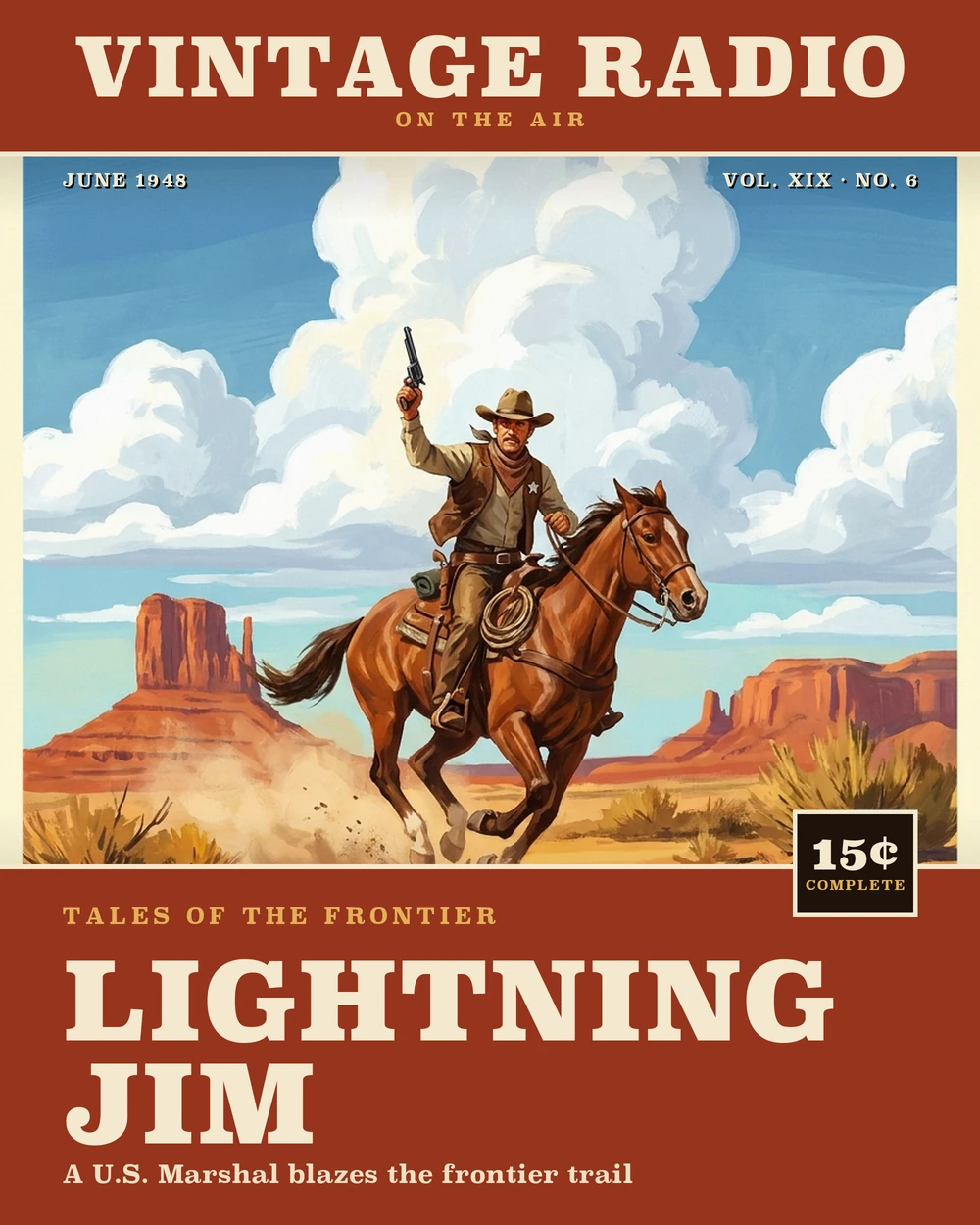
Lightning Jim
The Marshal Behind the Name
What set Lightning Jim apart from the general run of Western radio dramas was its star. The man behind U.S. Marshal Lightning Jim Whipple was Francis X. Bushman — a name that carried enormous weight in American popular culture. Bushman had been one of silent film's biggest attractions, billed as "the Handsomest Man in the World" at the height of his fame, and was best known to audiences of a later generation for playing Messala in the 1925 epic Ben-Hur. By the time he stepped into the role of Lightning Jim, he was already a radio veteran, having spent years on CBS's long-running serial Those We Love from 1938 to 1945. He brought a genuine presence to the part — and the part was a substantial one.
Marshal Whipple, as written, was no vague frontier drifter. He was a U.S. Marshal with a name, a badge, and a supporting cast. His deputy was Whitey Larson, played by Henry Hoople, and his horse went by Thunder. That specificity gave the show an identity that some Western dramas of the era lacked. The central character was drawn with both toughness and integrity, a combination that made him credible as both a man of action and a figure of law. The dynamic between Whipple and Larson gave the series a consistent human anchor across its episodes.
Two Runs, One Series
Lightning Jim had a longer and more complicated production history than its modest profile might suggest. The show originated as a West Coast radio program in the 1940s — one source places the beginning of that run as early as 1944 — before returning in the 1950s as a syndicated transcription series distributed by Frederick W. Ziv's company. By 1948, Ziv had become, by contemporary accounts, the largest packager and syndicator of radio programs in the country. The company's method was to record programs onto transcription discs and sell them market by market to local stations, bypassing the major networks entirely.
That syndication model meant Lightning Jim reached audiences without the promotional machinery of NBC or CBS behind it, but it also gave the show a durability that network scheduling couldn't always provide. Across both phases of its run, a total of 98 radio programs were produced — a substantial output for a series that doesn't often appear on the short list of canonical Western radio dramas. Of those 98 programs, roughly 41 are known to have survived.
What the Episodes Covered
The 12 episodes that form the core of the current catalog give a good sense of the show's range. Some are standard Western fare — "The Outlaw's Son," "The Snake Strikes," "Disorder In The Court" — built around the familiar mechanics of frontier justice. Others reach into the mythology of the American West more deliberately, with episodes like "Jim Meets Wild Bill Hickok," "Jim and Calamity Jane," and "Jesse James Helps The Marshall" bringing historical and legendary figures into Marshal Whipple's orbit. "Jim Visits Broken Horn" and "Jim Shows Black Bear The White Man's Trail" touched on Native American characters and themes, while "Union Pacific" drew on the history of the transcontinental railroad.
That breadth was characteristic of the series. Beyond the straightforward outlaw-chasing plots, the show aimed to give listeners a sense of the larger West — its history, its legends, its contested ground. The episode "The Canyon of Lost Souls" was listed in some catalogs under the alternate title "Belle Starr the Female Outlaw," which suggests that even within individual episodes there was room for figures from outside the standard marshal-versus-outlaw template.
The Way It Sounded
The show was built on dialogue, which was the working material of most radio drama, but the soundscape around that dialogue was put together with care. Galloping horses and gunfire were the reliable punctuation of the action sequences — the audio shorthand that told listeners where they were without a word of description. In a format where the entire picture had to be built in the imagination, those sounds were load-bearing elements, not decoration.
The standalone episode structure kept the show accessible to anyone tuning in for the first time. Each installment told a complete story, meaning no prior episodes were required to follow what was happening or why it mattered. That was a practical advantage for a syndicated program sold to stations that might run episodes in any order, and it also suited casual audiences who couldn't always be counted on to tune in week after week.
Beyond the Radio
The reach of Lightning Jim extended past the broadcast itself. Whitman Publishing of Racine, Wisconsin produced a single Better Little Book based on the series, titled Lightning Jim: US Marshall Brings Law To The West. These small, densely illustrated books were aimed squarely at children and young readers, and appearing in that format was a signal that a radio property had enough cultural traction to support merchandise. It placed the character alongside other Western heroes who had made the same jump from audio drama to the printed page.
The surviving episodes were later reviewed, cataloged, and certified as accurate in April 2010 — meaning the circulating episodes had been properly identified and labeled. That kind of careful archival work matters for a syndicated series, where episodes could travel through many hands and accumulate errors in labeling along the way. The certification gave researchers and listeners a reliable baseline for what they were actually hearing.
Where It Fits
Lightning Jim arrived and ran during a period when the Western radio drama was one of the more reliably popular formats on American radio. Shows like Gunsmoke, The Cisco Kid, Death Valley Days, and Have Gun, Will Travel drew consistent audiences, and Lightning Jim occupied the same general space — a lawman hero, a recognizable landscape, clear moral stakes, and action that translated well to the audio medium. What distinguished it from the anonymous end of that field was the casting of Francis X. Bushman, whose film career gave the character a dimension a lesser-known actor might not have provided, and the ZIV syndication infrastructure that kept it in circulation across two distinct production phases.
The show never quite reached the canonical status of Gunsmoke, but 98 produced episodes over two runs with a star of Bushman's stature represents a more serious undertaking than the show's current obscurity might suggest. Within the Western genre and the range of what that format could do, Lightning Jim stands as a specific and well-defined example — a U.S. Marshal named Whipple, his deputy Whitey Larson, a horse named Thunder, and somewhere west of everything, a canyon of lost souls.